Ecuador has no winter tyre obligation and studs are not a normal fitment, even on páramo roads above 4,000 m. Volcanic ash and long Andean descents matter far more than any seasonal rule.
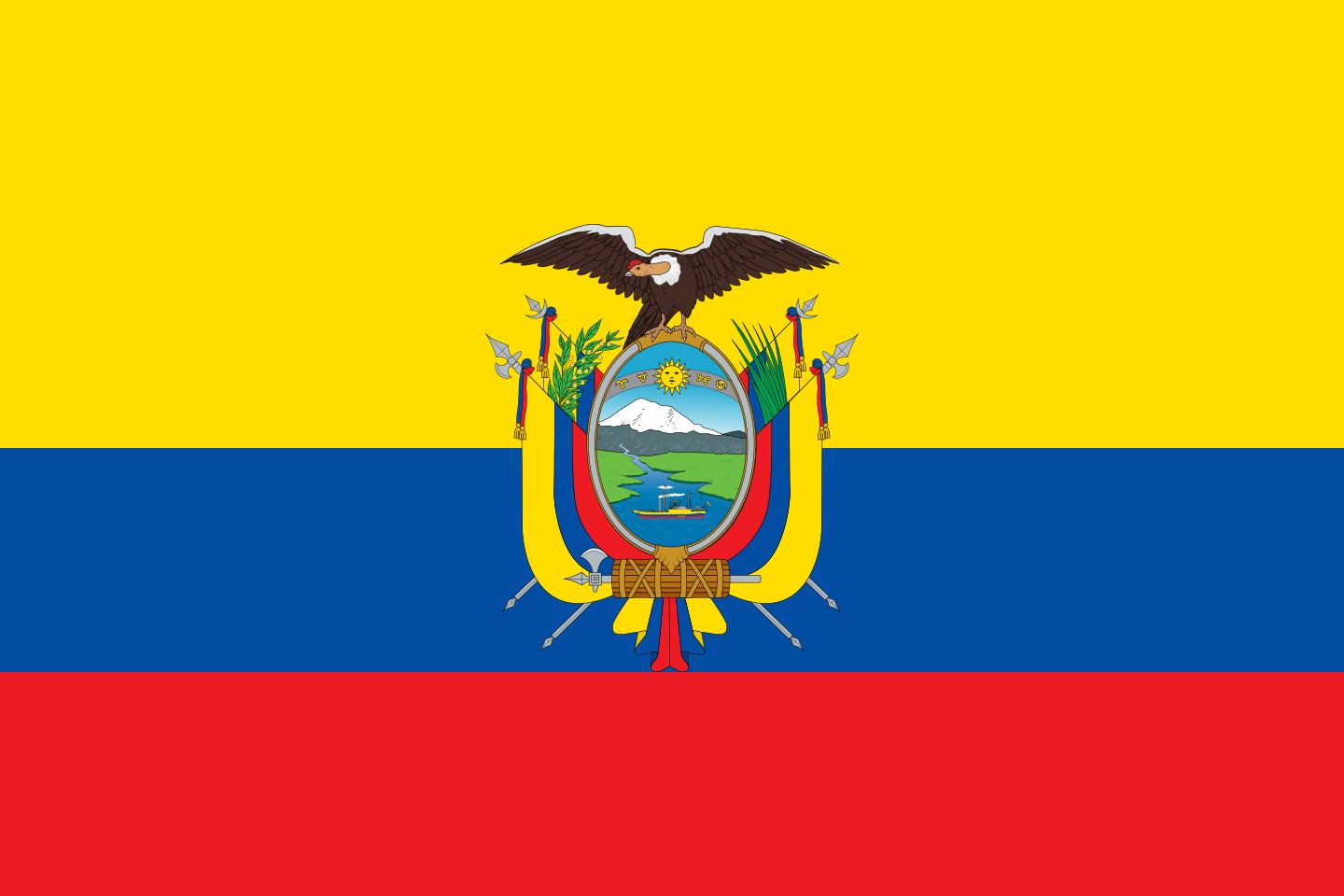
Ecuador 2026: Ash, Páramo Frost and No Winter Rule
Data verified:
3 min readEcuador drives on the right side of the road. The minimum driving age is 18. The motorway speed limit is 120 km/h. The general emergency number is 911. The legal blood alcohol limit is 0.03% BAC. An International Driving Permit (IDP) is recommended alongside a foreign licence.
Tyre details
- How the EU tyre label grades wet braking and rolling resistance — What each letter and pictogram on the sticker actually measures.
- What the speed letter on the sidewall allows — H, V, W and Y decoded, plus the sticker rule for lower-rated winter sets.
- Reading the load index before you buy replacements — The two- or three-digit number that caps weight per tyre.
- Tyre noise ratings in decibels — What the dB figure and the A, B or C class on the label mean inside the car.
- Calculate tyre pressure from your tyre size and load — A starting figure in bar and psi, then the door placard has the final word.
Personalise for Your Trip
See how Ecuador differs from your home country
Ecuador puts public roads above 4,000 metres — the Panamericana crosses páramo where frost, sleet and freezing fog are ordinary before sunrise — and it still has no winter tyre rule, no marking requirement and no stud mandate.
That is not an oversight. On the equator, high ground is cold every night and mild every afternoon. There is no winter to legislate for; there is a daily cycle instead. The risk that produces is different in kind, and it is handled by driving rather than by fitment.
Position summary
| Point | Position |
|---|---|
| Seasonal tyre obligation | None, at any altitude |
| Studded tyres | Not a normal fitment |
| Tread floor | 1.6 mm, main grooves |
| Practical replacement point | 3.0 mm |
| All-season tyres | Accepted |
| Driving side | Right |
The floor is the international reference from Council Directive 89/459/EEC, defined across the broad grooves in the central part of the tread.
Three countries inside one border
A single day can take you across conditions that would be three separate climates anywhere else:
- The páramo and the Andean spine — Quito at 2,850 metres, the Papallacta ridge above 4,000, the passes on the Panamericana between Cotopaxi and Chimborazo. Cold, wet, cloud-bound, with morning frost on shaded bends.
- The coastal plain — Guayaquil, Manta, the Ruta del Spondylus. Hot and humid, with a wet season roughly December to May that puts serious water on the road.
- The Oriente — the Amazon side, reached by long descents off the eastern cordillera. Rain most of the year and surfaces that break up under it.
Volcanic ash
Ecuador’s active chain sits directly beside the main highland corridor. Fallout from Cotopaxi, Tungurahua, Reventador or Sangay puts a specific hazard on the carriageway: fine ash acts as a dry lubricant between rubber and asphalt, while the coarser grains are sharp volcanic glass that abrades tread and sidewall.
The most dangerous moment is not the fall itself but the first rain after it, when the layer turns to slurry. There is no equipment answer — only lower speed, longer gaps, and a wash-down afterwards to get the grit out of the brakes.
Why the descents matter more than the passes
Climbing to 4,000 metres is an engine problem. Coming down is a brake problem, and Ecuador’s descents are long: Quito to the Oriente, or the drop from the sierra to the coast, sheds several thousand metres in a single run. Pads fade, fluid heats, rims get hot and that heat reaches the tyre.
Select a gear that holds the vehicle and leave the brakes for corners. And gauge the shoulder of your tyres as well as the centre grooves — continuous hairpins wear the outer ribs first, so the worst reading is usually not the one in the middle.
Two neighbours
- Colombia — north, at Rumichaca on the Panamericana and San Miguel in the Oriente.
- Peru — south and east, at Huaquillas on the coast and Macará in the sierra.
Chile, Venezuela, Suriname and Uruguay are sometimes grouped with them but share no frontier with Ecuador; the Galápagos sit about 1,000 kilometres out in the Pacific with their own, separate road network.
Speed limits, documents, fines and mandatory equipment are covered in the Driving in Ecuador guide.
Tyre Regulations Summary
| Winter Tyres | Not required |
| Period | No fixed dates |
| Min. Tread Depth | 1.6 mm |
| Studded Tyres | Restricted |
| All-Season | Accepted |
| Marking | — |
Driving through more than one country this winter? Compare winter tyre rules, dates and legal tread depths for every country →
Driving in Ecuador — Key Facts
Speed Limits
- Urban: 50 km/h
- Rural: 90 km/h
- Motorway: 120 km/h
Emergency Numbers
- Police: 911
- Ambulance: 911
- Fire: 911
- General: 911
Required Equipment
- Warning Triangle: Required
- Reflective Vest: Required
- First Aid Kit: Required
- Fire Extinguisher: Required
Country Info
- Capital: Quito
- Driving Side: Right
- Languages: Spanish
- Currency: United States dollar ($)
- Population: 18,103,660
Useful Driving Phrases in Spanish
| English | Spanish |
|---|---|
| Where is the nearest petrol station? | ¿Dónde está la gasolinera más cercana? |
| I need help / roadside assistance | Necesito ayuda / asistencia en carretera |
| Where can I park? | ¿Dónde puedo aparcar? |
| How do I get to the motorway? | ¿Cómo llego a la autopista? |
| I had an accident | He tenido un accidente |
| Speed limit | Límite de velocidad |
| No parking | Prohibido aparcar |
| One way street | Calle de sentido único |
| Toll road | Autopista de peaje |
| Fill up the tank, please | Lleno, por favor |
Complete Driving Guide for Ecuador
Speed limits, traffic rules, mandatory equipment, license requirements and more.
View driving guideRenting a Car in Ecuador?
Compare prices from all major rental companies. Free cancellation on most bookings.
Compare Car Rental PricesSome links on this page are affiliate links. We may earn a commission at no extra cost to you. How our affiliate links work.
Frequently Asked Questions
No. The páramo passes on the Panamericana and the road over the Papallacta ridge run above 4,000 metres with frost, sleet and freezing fog, and Ecuadorian rules still impose no seasonal tyre obligation, no marking requirement and no stud mandate.
Because Ecuador sits on the equator, its high ground is cold every night and mild every afternoon rather than cold for months on end. There is no season to legislate against, so the risk shows up as morning ice on shaded bends instead of a winter to prepare for.
Fallout from Cotopaxi, Tungurahua, Reventador or Sangay behaves as a dry lubricant under the tyre while the coarser grains abrade rubber. The worst moment is the first rain afterwards, when it turns to slurry. Speed and distance are the only controls.
1.6 mm in the main grooves is the international reference floor from Council Directive 89/459/EEC. On Ecuadorian gradients, in páramo drizzle and on the wet coastal plain, 3 mm is the point to replace at.
Two: Colombia to the north and Peru to the south and east. Chile, Venezuela, Suriname and Uruguay are elsewhere in South America and share no frontier with Ecuador. The Galápagos lie about 1,000 km offshore.
Related Articles
Are Dashcams Legal in Austria? No — EUR 10,000 Fine in 2026
Country-by-country status for 2026, which courts accept the footage, the confiscation risk at an Austrian stop, and the rule that catches hire cars.
Driving LawsEurope Speeding Fines 2026: EUR 15 to an Uncapped Day-Fine
The same 20 km/h over the limit costs EUR 15 at the cheap end and EUR 70 on a German Autobahn, and in Switzerland a share of income with no ceiling.
Driving LawsRadar Detectors Legal in Europe 2026: 5 Bans, €1,500 Fine
The 2026 table for all of Europe: hardware versus camera-warning apps, five outright bans, France's EUR 1,500 seizure and Germany's EUR 75 use-only rule.
Driving in Ecuador
Speed limits, driving rules & travel tips
 Colombia
 Peru
Peru Brazil
 Venezuela
 Bolivia
 Chile
Chile