
Krefeld Umweltzone 2026: Green-Only Since July 2012
Umweltzone · Germany · Active since 2011-01-01
Source: official source · Verified: 2026-09-19
The zone opened on 1 January 2011 and has accepted only the green Plakette since 1 July 2012. Diesel needs Euro 4 or Euro 3 with a filter; petrol needs a regulated catalytic converter. Fine: €100.
Locally the zone is called Umweltzone Krefeld (Germany) — that is the wording on the boundary signs, on the official portal and on any penalty notice, so it is the phrase to search for once you are there.
Next
- Check your own car against Krefeld — enter your fuel and Euro class, get a yes or no in one step.
- Mönchengladbach has a zone too — the nearest one to Krefeld, and the rules are not identical.
- If a fine arrives after you get home — who pays on a hire car, and what is actually enforceable across borders.
Practical answers for Krefeld
- When is the Krefeld zone active?
- 24/7 That means there is no free window — the restriction applies on Sundays and public holidays too.
- How much does it cost to drive into Krefeld?
- EUR 5-15 · Green Umweltplakette (Schadstoffgruppe 4) Get it wrong and the penalty is EUR 100.
- Do I need to register or buy anything first?
- Green Umweltplakette (Schadstoffgruppe 4) Official portal.
- Who is exempt in Krefeld?
- Vehicles with a German E-plate or the blue E badge for foreign-registered EVs (FZV § 11), from 1 Oct 2026, Historic vehicles (H-plate), Emergency vehicles and Military vehicles. Exemptions are usually not automatic — most require registering your number plate in advance.
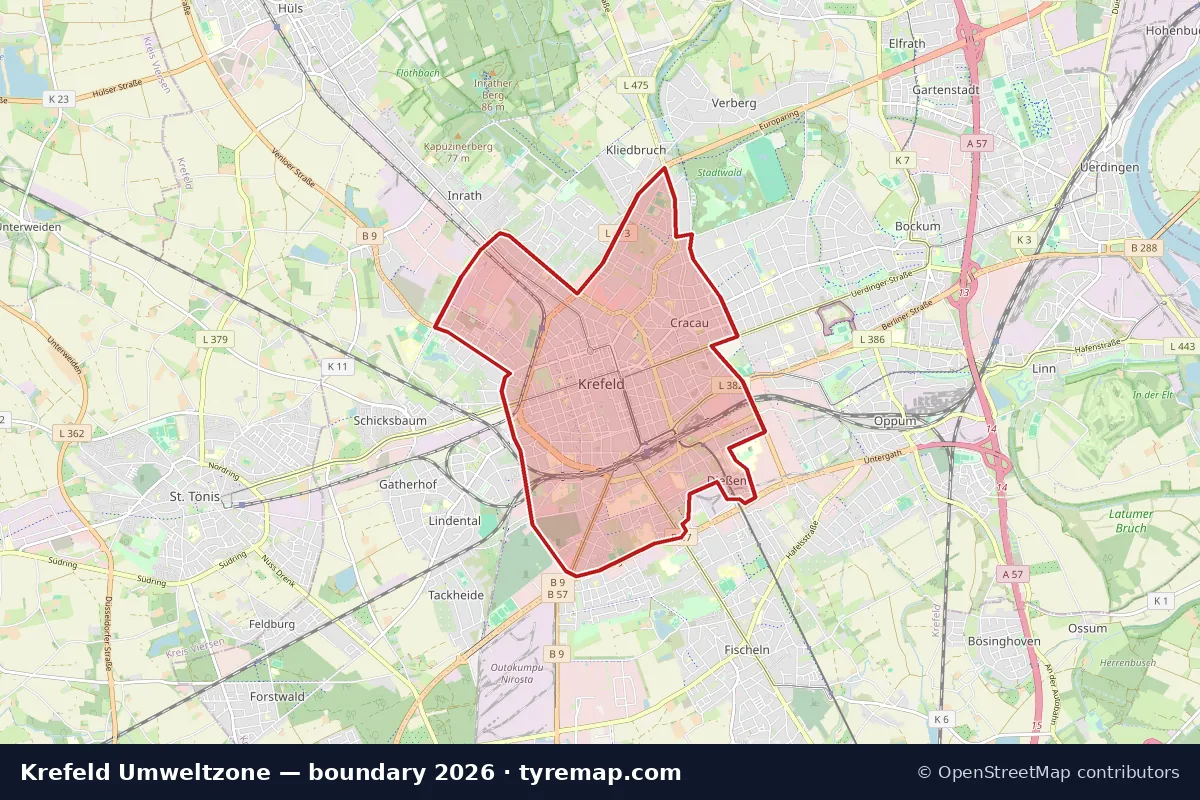
Krefeld Umweltzone Map
The shaded area is the zone boundary as mapped in OpenStreetMap — zoom in to see which streets fall inside, and confirm the signs at the edge on arrival.
Requirements
Who pays in a hire car, whether insurance covers it, and how to appeal.
Can My Vehicle Enter Krefeld?
Select your fuel type and Euro emission class to check instantly.
Exemptions
Driving Guide: Germany
Speed limits, traffic rules, and equipment requirements for Germany.
View driving guideNearby zones in Germany
Renting a Car in Krefeld?
Compare prices from all major rental companies. Free cancellation on most bookings.
See Krefeld Rental PricesSome links on this page are affiliate links. We may earn a commission at no extra cost to you. How our affiliate links work.
The federal Umweltzonen register dates Krefeld’s zone to 1 January 2011, with the green-only stage arriving on 1 July 2012. Since then the rule has not moved: a green Umweltplakette on the windscreen, meaning diesel from Euro 4 (or Euro 3 with a particulate filter) and, for petrol, no more than a regulated catalytic converter. Anything else is a flat €100. Electric and hydrogen cars are in the green class by default.
| Fact | Value |
|---|---|
| Zone type | Umweltzone |
| City | Krefeld |
| Country | Germany |
| Sticker / registration | Green Umweltplakette (Schadstoffgruppe 4) |
| Sticker cost | EUR 5-15, once, for the life of the vehicle |
| Fine | EUR 100 (no Flensburg point since 2014) |
| Petrol minimum | Euro 1 with a regulated catalytic converter |
| Diesel minimum | Euro 4, or Euro 3 with a particulate filter |
| Operating hours | 24 hours a day, every day |
| Zone opened | 1 January 2011 |
| Green sticker only since | 1 July 2012 |
Can your car enter Krefeld?
Enter your vehicle's fuel + Euro class → instant verdict for Krefeld (Umweltzone). Fine if wrong: EUR 100.
Krefeld Emission Zone
Krefeld sits on the left bank of the Rhine, just north-west of Düsseldorf, and its Umweltzone covers the built-up core of the city. The boundary is marked with the round green sign at every approach road; there is no gate and no toll point, so the sign is the only warning you get.
Who gets the green sticker
The threshold is federal, not municipal. The Umweltbundesamt sets it at diesel Euro 4, or Euro 3 with a particulate filter, and petrol Euro 1 or better with a regulated catalytic converter. The petrol line is far lower than most visitors assume: a mid-1990s petrol car with a working cat qualifies, while a 2004 diesel does not.
Buying the Plakette
It costs about €5 to €15 at a TÜV or DEKRA station, a licensed workshop or the registration office, and around a week if you order online from abroad. You buy it once; it has no expiry date and it is valid in every German Umweltzone. Hire cars from the large German agencies already carry one, but it is worth a glance at the windscreen with a smaller local firm.
Checks and the fine
German Umweltzonen are not enforced at entry cameras. Police and municipal officers check windscreens, including on parked cars, which is why a sticker left in the glovebox is no defence. The rate is €100, and since 2014 it carries no Flensburg point. Satnavs are no help either — routing software does not reliably know where the boundary runs.
Exemptions
Cars with an E-plate (since 1 October 2026; a foreign-registered EV needs the blue E badge), H-plate classic cars, emergency and military vehicles all sit outside the requirement. A classic with an H-plate does not have to prove anything further: the plate itself is the evidence.
Recent changes to this page
- Electric-car rule brought up to date: from 1 October 2026 a car with a German E-plate, or the blue E badge that foreign-registered EVs can get, needs no green sticker (35. BImSchV Annex 3 no. 11, added by BGBl. 2026 I Nr. 278). An electric car without that marking still needs the sticker.
- Verified against the Umweltbundesamt register: the zone came into force on 1 January 2011 and reached the green-only stage on 1 July 2012 — the page had said 2008 — and the petrol threshold is a regulated catalytic converter (Euro 1 and newer), not Euro 4.
- Title, description and introduction rewritten from this page's own data (no shared template wording).
- Re-verified fine (EUR 100) and requirements against Germany authority portal.
- Confirmed Green Umweltplakette remains mandatory; 2026 ruleset unchanged.
- Updated enforcement procedure notes after seasonal review cycle.
Part of the TyreMap Emission-Zone Dataset — 596 verified European emission zones, free to reuse under CC BY 4.0.
Frequently Asked Questions
Yes, the green Umweltplakette. The zone opened on 1 January 2011 with the earlier stages and has accepted only the green sticker since 1 July 2012. Yellow and red stickers are worthless here.
Diesel from Euro 4, or Euro 3 with a particulate filter. Petrol needs only a regulated catalytic converter — Euro 1 and newer, so roughly anything first registered from 1993. Cars without a combustion engine are placed in the green class too, and since 1 October 2026 a car with an E-plate needs no sticker at all.
€100, the national rate for driving in an Umweltzone without a valid Plakette, and it applies whether you are inside for two minutes or all day. The Flensburg penalty point that used to accompany it was scrapped in 2014.
TÜV and DEKRA testing stations, licensed garages and the vehicle registration office sell it for about €5 to €15. Online orders take roughly a week. It is bought once and stays valid for the life of the vehicle, in every German Umweltzone.
Since 1 October 2026, yes, if the car has a German E-plate or the blue E badge issued to foreign-registered EVs. Before that date electric cars were simply placed in the green class and had to show the sticker, and an EV without the E marking still does.