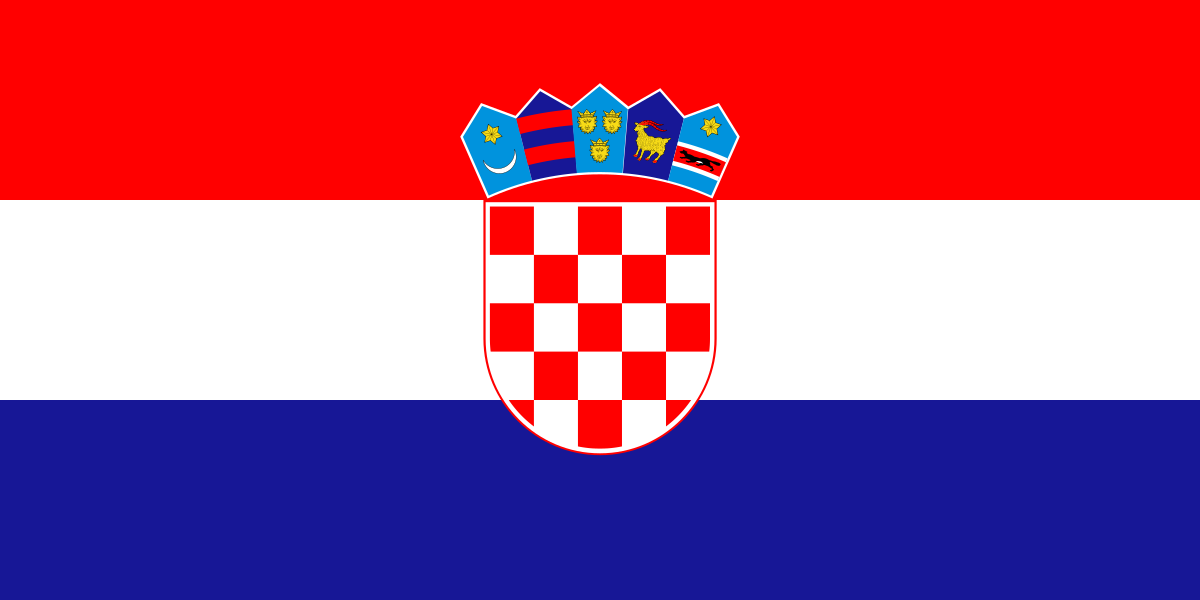
Croatia on an Austrian Licence — No Vignette, Ticket Tolls & the Coast Run
 Austria
Croatia
Austria
Croatia
Your Austrian licence is enough for Croatia — no IDP, no separate document. The surprise for Austrians is tolling: Croatia has no motorway vignette like home. You pull a ticket at the entry barrier and pay by the kilometre at the exit, and the A1 booths to Split queue badly in August.
For Austrians, Croatia is one of the easiest foreign drives there is — same side of the road, same 0.05 alcohol limit, euros in the wallet since 2023, and an EU licence that needs nothing bolted onto it. The one genuine adjustment is how you pay to use the motorway.
Forget the vignette — Croatia tolls by ticket
At home you slap an Austrian vignette on the windscreen and drive. Croatia works the opposite way. There is no motorway vignette. You take a ticket at the entry barrier of the A1, A6 or A3, keep it safe, and pay at the exit based on how far you travelled — card or cash, euros either way. The A1 down to Zadar, Šibenik and Split is the corridor most Austrians use, and in late July and August the exit booths near the coast queue for thirty minutes or more. Get in the ENC (electronic) lane only if your rental has a tag; otherwise the manual lanes move faster than they look.
Heads-up on the journey itself: the leg through Slovenia still needs a Slovenian vignette, which you buy before the border — check our Slovenia vignette guide so you are not caught at Karawanken.
What stays the same — and what doesn’t
The familiar parts are real. Town limit is 50 km/h, the open road is 90 (slightly below Austria’s 100), and the motorway tops out at 130 like the A2 at home. The drink-drive line is 0.05, identical to Austria, so there is nothing new to memorise — just know the coast road sees heavy alcohol checks on summer evenings.
The car must still carry a warning triangle, reflective vest, first-aid kit and spare bulbs, the same kit you keep at home. Petrol runs about €1.65/litre. Speed is enforced by fixed cameras and mobile patrols, and a typical 10 km/h overshoot costs €30-60 on the spot — estimate yours with the Speeding Fine Calculator.
The bigger seasonal hazard is congestion, not speed: Dalmatian old-town streets in Split, Trogir and Dubrovnik are tight and one-way, so park outside the walls and walk in. Full local detail is on our Croatia driving guide, and you can confirm you need nothing extra with the Driving Permit Checker. Emergencies are 112.
Speed limits, fines, equipment & license requirements
Your home country driving rules for reference
Side-by-side driving rules comparison
Renting a Car?
Compare prices from all major rental companies. Free cancellation on most bookings.
Compare Car Rental PricesSome links on this page are affiliate links. We may earn a commission at no extra cost to you. Learn more.
More Free Tools
Explore TyreMap
Winter tyres in Croatia — 2026–27 season
Winter tyres are compulsory on fixed dates in Croatia: 15 November - 15 April.
- Tread minimum: 1.6 mm — Croatia sets no separate winter figure.
- Accepted marking: M+S / M.S. / M&S or 3PMSF
- Studded tyres: banned
- Penalty: EUR 130 (driver)
In Croatian the rule is zimske gume, and snow chains are lanci za snijeg — that is the wording on signs, in hire-car paperwork and on any penalty notice.
Verified against national legislation, August 2026 · Full Croatia tyre law · Compare all countries
Frequently Asked Questions
Neither. Croatia does not use a vignette system on its motorways. You take a ticket entering the A1 or A6 and pay cash or card at the exit barrier based on distance. The drive down through Slovenia, however, does need a Slovenian vignette.
Yes — your EU licence is fully valid and no International Driving Permit is required. Croatia has used the euro since 2023, so tolls and fines are priced in euros, not kuna.
Both countries sit at 0.05 BAC, so there is no change to learn. Croatian police run frequent summer checks on the coast road, and a speeding fine for 10 km/h over is EUR 30-60 depending on the exact margin (higher outside town).